
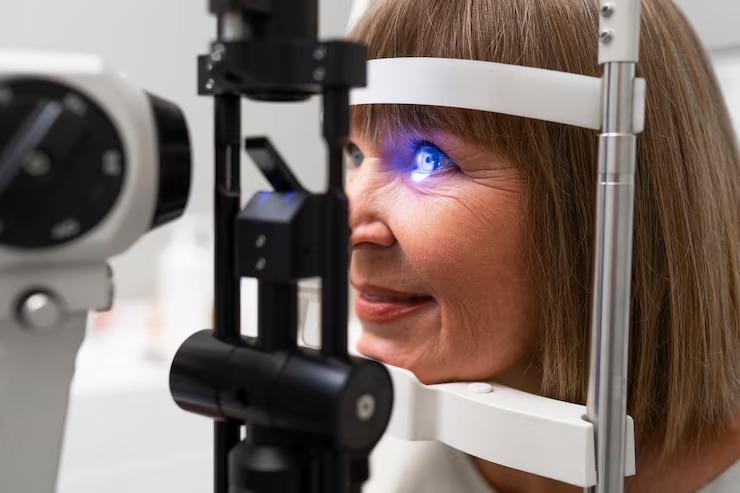
Laser Eye Surgery: What is it? Benefits and risks
Laser eye surgery has long been a popular alternative to traditional glasses and contact lenses for vision correction. In this article, we'll learn more about laser technology, its types, complications, risks, who is a suitable candidate, who is not a suitable candidate, and its benefits.
What is laser eye surgery?
It's a surgical procedure that reshapes the cornea and corrects many vision problems. It has both positive and negative effects.
Who are candidates for laser eye surgery?
People with refractive errors, which occur when the eye fails to focus light onto the retina at the back of the eye. The main types of refractive errors include:
Hyperopia (farsightedness): Light focuses behind the retina instead of on it. Therefore, we see distant objects more clearly, but near objects appear blurry. Laser eye surgery can correct this error by reshaping the cornea to have a sharper curve.
Nearsightedness (myopia): Light rays focus in front of the retina, blurring distant vision. Therefore, we see things clearly when they are close, but distant objects appear blurry. Healthcare professionals can correct this with laser eye surgery by reshaping the cornea.
Astigmatism: When the cornea curves or flattens unevenly, the result is astigmatism, which disrupts the focus of both near and far vision. This irregular curvature of the cornea can be corrected with laser eye surgery in some cases.
In addition to correcting refractive errors, laser eye surgery is also used to treat other conditions such as:
Glaucoma
Cancer
Cataracts
Who are not candidates for laser eye surgery?
They are individuals with any of the following conditions:
Thin corneas
Dry eyes
Pregnancy or breastfeeding
Are in their twenties or younger, although some experts recommend a minimum age of 18
Severe irregular astigmatism
Autoimmune diseases or other conditions that prevent healing
What are the benefits of laser eye surgery?
After laser eye surgery, people who wear corrective glasses no longer need to wear them. Some people choose laser eye surgery, perhaps because they prefer not to wear corrective glasses or perhaps for cosmetic reasons.
What are the risks of laser eye surgery?
The following conditions increase the risk of laser eye surgery:
Glaucoma
Eye infections such as keratitis or ocular herpes
Complications and side effects of laser eye surgery include:
Vision disturbances such as glare or halos
Sensitivity to light
Redness or redness of the whites of the eyes
These symptoms usually disappear within the first few days.
What are the types of laser eye surgery?
LASIK: The doctor creates a flap in the outer layer of the cornea to access the tissues underneath. Then, a laser is used to reshape the tissues beneath the cornea so that light can be focused correctly. The flap is what distinguishes LASIK from other procedures.
Femto-SMILE (Smile) surgery
PRK (Percutaneous Keratomileusis): The surgeon uses a laser to reshape the cornea. However, it only affects the surface of the cornea and not the tissue beneath it.
After reading this article and learning so much about laser eye surgery, would you prefer to undergo this procedure or not?